

By Narada Thomas
The outbreak of the pandemic past two years has changed all of our worlds. And not just in the short term. A few countries ordered people to stay at home, many closed their borders, and the hospitality industry lost many workers. But now, it seems like the world is starting to get back to its feet. Now that things are slowly beginning to return to “Normal,” When I travelled outside of Canada in March, I realized how travelling became more challenging than in the pre-pandemic era.
Airports and stations were more crowded and had longer waiting times than in the pre-pandemic era. While waiting for my turn at the airport, I had a hard time understanding announcements because of the noise and lack of visual clues. Everyone at the airport and stations were wearing masks which made me challenging to communicate with attendants, fellow travellers, and security personnel.
Despite being understaffed and busy, most representatives were patient and accommodated travellers. Some venues had installed new signs and visual clues which were helpful to navigate and ask for help. Being a self-advocate for my hearing loss and accessibility needs, some of my initiatives helped me to overcome the challenges I faced during my trip.
Is travelling safe?
While most countries are loosening their covid restrictions, some still require vaccination status, covid tests, and travel insurance. So before you make firm plans, make sure there are no significant travel warnings or health advisories in your destination. Finding correct and most up-to-date information can be a daunting task. But proper preparation can prevent you from some unexpected surprises.
- Check Canada’s International Travel Advice and Advisories (https://travel.gc.ca/travelling/advisories) for your destination’s travel advisories.
- Collect the contact information (phone number, email, social media accounts, and address) of all important places in advance. In case of an emergency, Having the most accessible information can be helpful.
- Embassy or closest embassy of Canada in your destination
- Your lodgings or hosts’ contact information
- Check for accessibility features and accommodations provided by your lodging and attractions you want to visit. You can contact them as part of your planning.
- For example, you can check if your hotel has visual alerting devices, closed captioning TV, and whether they can provide the accommodations you need.
- Check if museums and guided tours have hearing loops.
- If you have one, Your Travel agent may be able to help with some of your accommodation needs.

HuMask Pro Vision Transparent Mask helped me to communicate with others better. I had extra unused masks for people I communicate often during the trip.
Preparing for travel:
During your trip, act as your advocate. Hearing loss is an invisible disability, and many people may not be aware of your needs and struggles. Some countries and cultures accommodate persons with hearing loss differently. It is important to be upfront about your requirements and be proactive.
- Make sure you have all required documents and meet the requirements of your destination and for re-entry to Canada.
- Install and test Speech-To-Text apps and Translation apps on your smartphone. Some apps work offline without a data connection.
- Some Speech-To-Text apps: Live Transcribe (Android), DeafNote (Android) Speechy (iOS), Transcribe (iOS)
- Some Translation apps: Google Translate (Android and iOS), Microsoft Translator (Android and iOS)
- A notepad and pen can be a lifesaver.
- Write or print down some important phrases in both English and your destination’s language
- Take the notepad and pen with you in your jacket, backpack, handbag, or pocket while you are travelling.
- When booking and checking in your flights, trains, ferries, or buses, indicate that you have a hearing loss.

When you inform Airport staff about your hearing loss, They can assist you better. An airport staff wrote down the new gate for my connecting flight when it changed last minute. - Inform representatives in the airport, train stations, bus depots, and ferry terminals that you need direct and in-person communication about delays and boarding.
- Sit or wait near check-in gates. Arriving at your airport, train or bus station early allows you to locate and inform your representations of your conditions and additional assistance you might need.
- Similarly, introduce yourself to receptions, concierges, park rangers, or other service providers.
- Keep your hearing aid accessories such as chargers and batteries in protected and easily accessible areas such as your backpack or carry-on bag.
- Pack cleaning supplies and hearing-aid safe sanitizing kits.
- If you are travelling to a humid climate, consider a dehumidifier for your hearing aids.
- Wearing transparent window face masks can reduce communication barriers for yourself and others.
- Purchase transparent medical masks to wear during travelling and pack a few for people you may communicate with frequently during the trip. You can order Humask Pro Vision masks from CHHA Store: https://shop.chha.ca/
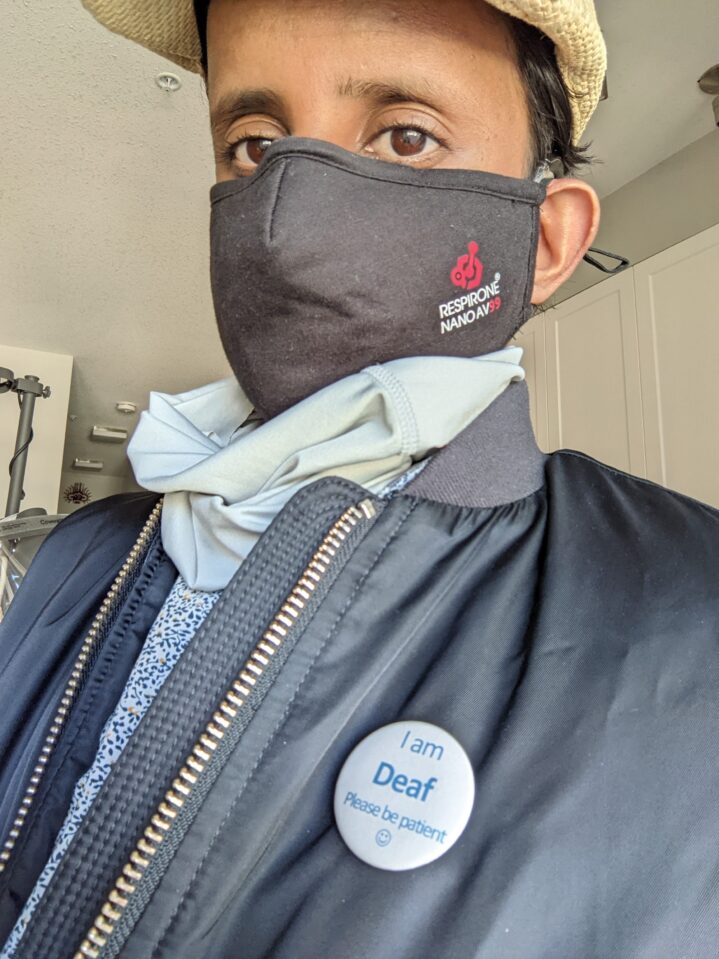
“I am deaf, please be patient” was a non-verbal clue that I have a hearing loss
- Purchase transparent medical masks to wear during travelling and pack a few for people you may communicate with frequently during the trip. You can order Humask Pro Vision masks from CHHA Store: https://shop.chha.ca/
- You can also wear a button or note indicating you have a hearing loss. Etsy (https://www.etsy.com/ca/search?q=deaf%20button) and some organizations sell those buttons and badges.
Contact your audiologist to check if your hearing aid and cochlear implant have features (programs. Bluetooth connectivity, T-coil loop, hearing aid apps, and hearing aid accessories). Travelling after the pandemic will be a new experience for all of us. And while there are a few extra steps we need to take to stay safe, I am sure your trip will still be enjoyable!
Bon Voyage!